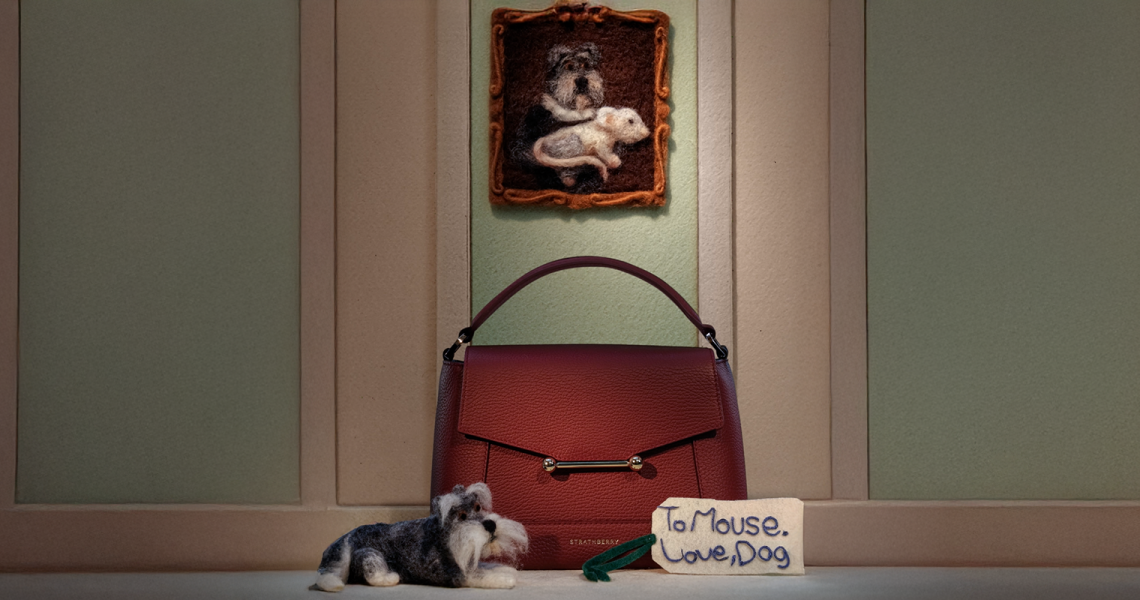
In this week’s Luxury Briefing, a look at how handcrafted storytelling is becoming luxury’s antidote to AI fatigue, as seen in creatives like Strathberry’s holiday campaign. Plus, Kay Barron’s new venture, Vvend. In earnings, Burberry, On and The RealReal show where demand is on the rise. Executive moves include Balmain’s appointment of Antonin Tron. And in News to Know, McQueen restructures. For tips and comments, reach me at zofia@glossy.co
Luxury brands are rethinking what “craft” means in the digital age. And this holiday season, that means slowing down. Across fashion and beauty, creative directors are trading AI’s hyper-efficiency for a sense of warmth, tactility and time. From Edinburgh to New York, studios and brands are choosing stop motion, handcrafted sets and tactile storytelling as a deliberate counterpoint to the artificial precision dominating the ad world.
For Scottish luxury accessories label Strathberry founded in 2013, that choice has manifested in felt and wool. Its 2025 holiday campaign, created with Prague-based studio So Daze, follows a Giant Schnauzer named Jess, inspired by the founders’ own dog, as she crafts the perfect Christmas inside a miniature version of Strathberry’s Edinburgh townhouse. The film’s intricate set includes more than 400 individually cut and hand-placed bricks, custom-felted materials and miniature Strathberry bags, all color-matched by hand. Each second of the 20-second campaign video is composed of still photographs (2,282 frames in total) meticulously retouched and animated by an eight-person international team.
The production process began in August and took more than 290 hours to complete. “When we first worked with So Daze in the spring, the warmth that came through the way the content was delivered really resonated with who we are as a brand,” said Strathberry co-founder Leeanne Hundleby. “We talk about being heartfelt, about warmth. It felt like something we wanted to extend.”
The stop-motion storytelling arrives amid an industry-wide unease with AI-generated advertising. Coca-Cola’s 2025 “Holidays Are Coming” ad, produced with AI studios Silverside and Secret Level, has drawn widespread criticism for its uncanny, video game-like visuals. Aerie’s “No AI, Real People” campaign, launched in October, became its most-liked Instagram post of the year. Polaroid and Heineken have taken similar stances, leaning into “analogue authenticity.” The public’s appetite for emotion and proof of human touch appears to be outweighing fascination with generative novelty.
Michael Feder, co-founder of the New York creative studio Hornet, said the trend reflects a deeper truth about how brands now view storytelling. “AI isn’t something that’s going to ruin or take over our business,” he said. “It’s a tool, but the reason people come to us is for the human side and the story side. They come for the quality that can only be done by people.”
Hornet, which has worked with Apple, Meta, Google, Adobe, Amazon, Spotify and Airbnb, has seen an influx of luxury brands experimenting with AI at the R&D level but stopping short of letting it define campaigns. “Clients are curious,” Feder said. “They’re asking, ‘Can we use AI to scale smaller deliverables, while keeping the human authorship for the main creative?’ That’s where the conversation is now.”
Ad position: web_incontent_pos1
Feder acknowledged that cost pressures are driving brands to test automation, but said the most successful collaborations continue to rely on storytelling anchored in artistry. “If AI can make a process faster or free up artists for more creative roles, great. But when it comes to the big holiday campaign, that’s still about authorship. It’s about creating something people can feel,” he said. “Consumers can tell when something’s made by AI. It doesn’t feel human. Something’s not quite right.”
That tension between automation and authenticity is shaping how agencies, studios and brands work together. Feder described the current dynamic as “a moment of curiosity, not panic.” “We’re not hiring AI directors,” he said. “The core of our business is authorship, story and quality. That hasn’t changed. If anything, AI has made that more valuable.”
For Strathberry, the same logic applies. “We wouldn’t have wanted to achieve a stop motion using AI; we’d know it wasn’t right,” said co-founder Guy Hundleby. “It might look nice, but it would be like if you could just magic up [our] bags in a big machine and pump them out. That’s not what we’re about. We’re about doing things slowly, carefully, by hand.”
That parallel between process and product defines Strathberry’s identity. Each of its handbags can take up to 20 hours to craft, composed of more than 80 pattern pieces and over 200 stitches, all finished by artisans in Ubrique, southern Spain, the same workshops used by Europe’s top luxury houses like Loewe. “It’s like how every piece of stop motion comes together to make a final picture,” said Leeanne. “Nobody knows how many pieces went into that bag, and nobody knows how many frames were tweaked so the little characters showed each other love. It’s like a dance that all comes together beautifully.”
Severin Matusek, founder of Co-Matter, a Berlin-based strategy studio that has worked with Mozilla, WeTransfer and L’Oréal, said this collective turn toward tactile storytelling is symptomatic of a larger cultural moment. “We’re in a kind of soul-searching era,” he said. “AI has made everyone question what makes human creativity unique. There’s an uncanny feeling people get when they look at something generated. It’s not just aesthetic, it’s emotional.”
Ad position: web_incontent_pos2
Matusek described AI as both a technological innovation and a cultural scapegoat. “AI has become the latest symbol of everything that’s gone wrong with how tech has evolved, like loss of jobs, speed over substance and a sense that no one was asked whether we even wanted this,” he said. “Luxury brands can sense that anxiety, and they’re moving in the opposite direction, toward things that feel slow, original and irreproducible.”
For Strathberry, that principle extends beyond digital. The brand has brought its stop-motion story into physical retail, recreating the snowy townhouse scene and felt characters in its Edinburgh and London store windows. Founded in 2013, Strathberry has grown into a global luxury label with stores in the U.K. and a presence in Saks Fifth Avenue, Neiman Marcus, Bloomingdale’s and Nordstrom. Its structured leather bags, marked by a signature gold bar closure, sit in the accessible luxury category and attract a global audience, with the U.S. now its fastest-growing market. It declined to share revenue numbers.
Strathberry is not alone among luxury brands are finding creative refuge in handcrafted storytelling. Loewe’s 2019 holiday film, “An Otter’s Tale”, merged stop motion with live action to evoke whimsy and warmth, while Hermès has long used playful stop-motion shorts to spotlight its scarves and accessories as miniature works of art. These campaigns established a precedent for using animation as a language of luxury — both playful and precise, rooted in craft rather than code.
Matusek sees this broader revival as a sign of a culture craving friction. “People are tired of frictionless everything,” he said. “They want to feel texture again in the stories, in images, in the world around them.”
Leeanne agreed that tactility is more than a design choice. “We live in this world of slow luxury,” she said. “Our designs are timeless, made to last. [In the stop-motion animation], somebody has painstakingly spent time and effort making every little light go round, every box getting wrapped by those tiny paws.”
Feder believes this is just the beginning of a new creative cycle. “The pendulum always swings,” he said. “We spent a decade making everything faster, smoother and more optimized. Now the pendulum’s swinging back to work that feels human, and that’s where the best storytelling happens.”
Inside Vvend: Kay Barron on why luxury finally needs a new video language
Vvend, Kay Barron’s new creative studio for luxury video, content production and live-commerce strategy has already attracted attention from major houses across fashion, beauty and jewelry. “The amount of brands, and the level of brands, that immediately got in touch” proved just how quickly the market is shifting, she said, though she declined to name the brands she’s working with. Barron was formerly fashion director at Net-a-Porter and is the author of the best-selling book “How to Wear Everything.”
As a creative studio rather than a platform, Vvend’s videos sit directly on brands’ own channels, such as their website, their app or their social media accounts, with the placements often powered by Bambuser’s video-commerce technology.
Barron said luxury’s slow uptake of livestream shopping has had little to do with fear of cheapening the brand and everything to do with internal setup. “Fashion is built on newness, but it’s incredibly traditional in how it sells,” she said. “Everyone’s doing 800 jobs, so there’s that level of worry about the heavy lifting.” With limited in-house capability, many brands have leaned on daigou livestreamers, traveling Chinese sellers who broadcast from boutiques — the model drives volume but rarely reflects a brand’s tone or values.
Vvend aims to shift that dynamic by creating brand-led, luxury-caliber videos developed with in-house talent and consistent storytelling. Barron argues that the host is central to that success. “Likeability is integral. If you haven’t gripped someone in the first entry, you’ve lost them,” she said, adding that internal stylists and store teams often outperform influencers because “customers respond to consistency.”
Her experience at Net-a-Porter showed her how powerful the format can be. The retailer launched its livestream series in 2021, often using minimal equipment, including “an iPhone, one lighting person and someone uploading product”, Barron said. Yet, it saw unexpectedly strong results. “There was no price barrier,” she said, stating that fine jewelry and watches often sold through live demonstrations, thanks to the level of detail shoppers received. She also noted that returns on items featured in videos fell, as viewers could see garments move, drape and fit in real time, reducing surprises around fabric and proportion.
Barron said Vvend ultimately responds to something technology alone can’t solve. “Buying clothes is emotional,” she said. “AI can support teams, but it can’t hold someone’s hand through the experience. Video can.”
Earnings
- Burberry reported £1.03 billion ($1.29 billion) in first-half revenue, with Q2 marking its first comp-store growth in two years. CEO Joshua Schulman said there are now “proof points that Burberry Forward is the right strategic path,” highlighting how Daniel Lee’s £10,000 ($12,500) fringed trench was reworked into best-selling commercial styles selling for £2,500 ($3,100). Analyst Luca Solca said the strategy “seems to be resonating with customers,” supported by stronger full-price sell-through and improving wholesale demand. Outerwear, scarves and new wardrobing pieces are driving customer interest, with strong traction among Gen Z.
- On posted another standout quarter on November 12, with Q3 revenue climbing to CHF 794.4 million — roughly $994 million — up 24.9% year over year. Apparel was a standout, more than doubling to reach 8% of total sales and passing 1 million units sold in the quarter for the first time. The brand continues to outpace the broader sportswear market, driven by strong full-price demand, especially in Asia Pacific, where sales more than doubled. On has now raised its full-year revenue outlook to 34% constant-currency growth as momentum stays high across both footwear and its fast-scaling apparel business.
- The RealReal posted a strong Q3 on November 10, with GMV up 20% to a record $520 million, revenue up 17% and adjusted EBITDA rising to $9.3 million, driven by accelerating supply and expanding AI efficiencies. CEO Rati Levesque said “resale is no longer reacting to the fashion industry but driving it,” pointing to rising consumer adoption and the platform’s role in trend discovery. The company highlighted the growing impact of its AI-powered product intake system, Athena, which now touches 27% of items; CFO Ajay Gopal noted it “can save us a couple of dollars per item” as it scales to handling 30–40% of products by year-end. With 25% of new consignors now being from stores and high-value events unlocking millions in supply, Levesque said the growth playbook across sales, marketing and retail is “really coming together,” supporting raised guidance and momentum into Q4.
Executive moves
- Balmain has appointed Atlein founder Antonin Tron as its new creative director, replacing Olivier Rousteing. Tron will debut his first collection for the brand in March 2026.
News to know
- Kering says McQueen is “not for sale” and is instead accelerating a three-year restructuring plan focused on shrinking the retail network, cutting roles and leaning into more accessible price points. Annual revenue has fallen below €200 million (about $234 million), a steep drop from its more than €800 million (about $936 million) peak.
- Luxury stocks have jumped sharply — LVMH up 42%, Kering up 49% — raising pressure on brands to prove the recovery can hold through a holiday season that drives up to 30% of annual sales. China remains fragile, and U.S. luxury spending is down 3%.
- Kering and Mayhoola will inject €100 million (about $117 million) into Valentino after the brand breached loan covenants tied to its €530 million (about $620 million) financing. Valentino, which generated €1.3 billion (about $1.52 billion) in revenue in 2024, holds roughly €1 billion (about $1.17 billion) in debt. Kering has delayed its full takeover until 2028.
Listen in
This week on the Glossy Podcast, Danny Parisi and Zofia Zwieglinska discuss Teen Vogue’s consolidation under Vogue, Shein’s clash with French authorities and Olivier Rousteing’s exit from Balmain. Later, Danny speaks with Fashionphile co-founder Sarah Davis about luxury retail security in the wake of last month’s Louvre jewelry heist. Listen here.
Read on Glossy
Google is launching new AI checkout and call features for shopping. Inside Marshalls’ holiday campaign. How brands are tackling holidays amid tariffs. Fashion has a renewed love for rock ‘n’ roll.